Well, I found some today! I ran across a wonderful blog I'd like to share, called weedemandreap, which I think is a delightful name. The image below is a link to a comprehensive, illustrated, just plain happy article on soaking and sprouting. I highly recommend reading it, just to get thinking about it, even if you don't plan on implementing a sudden change.
Showing posts with label Nutrition. Show all posts
Friday, May 15, 2015
Soaking and Sprouting
I've mentioned before that I really try to grind my own grains and soak whole, dry, grains and beans. I posted some of the scientific/nutrition reasons about two years ago, but I had a hard time finding more solid and clear information to share.
Well, I found some today! I ran across a wonderful blog I'd like to share, called weedemandreap, which I think is a delightful name. The image below is a link to a comprehensive, illustrated, just plain happy article on soaking and sprouting. I highly recommend reading it, just to get thinking about it, even if you don't plan on implementing a sudden change.
Labels:
Nutrition
Friday, November 22, 2013
Parsley
I have a funny little parsley plant. It seems to only grow when growing season is done and frosts have begun -- but then, it's this sudden small flourishing spot of green amidst the cast-off pumpkin vines and tomato bushes. I planted it once, and it grew lots of robust green leaves (no seedheads) and then died off for winter, which I figured was the end of its life cycle. Then I saw it sprouting out again the next spring, so I shrugged and left room around it, wondering if it would again provide a bountiful parsley harvest. It didn't, in fact I could never even really find it again once everything else started to take over the garden area.
But late that fall, after I had uprooted all the dried remnants of my crops, there was a splash of bright green, apparently untouched by the cold, frosty mornings. Tender new leaves were putting their heads out in the center, while a handful of few-but-healthy fronds surrounded them. I cut a few and enjoyed them, figuring the plant was having one last hurrah...but this week, a full year later, there it is again sitting out there, lording it over all the crunchy fall debris in my garden. I took some more fresh-smelling, delightfully green leaves in last night and chopped them for our harira stew. The plant is still small, and I've never seen it bloom or grow in the height of the summer since that first year I sowed the seeds; but it's persistent, and I can't describe the surprising sensory experience of handling fresh-picked, tangy-crisp parsley in late November.
Today I was a reader in my daughter's third-grade classroom, and one of the selections I read them was Emily Dickinson's poem 'Hope' Is the Thing with Feathers. In my case, despite my doubts and frustrations with trying to get food out of the ground, maybe hope is the parsley with leaves.
Parsley is also pretty powerful stuff nutritionally, it turns out. Not surprising, I suppose, but it packs a bigger punch than I thought -- it's comparable to kale, even a little better, which is saying a heck of a lot. It's three times as anti-inflammatory as, say, fresh basil or cilantro, and twice as much so as spinach; it also has five times the iron of that spinach, and over double the vitamin C of an orange, gram-for-gram, though I suppose you'd eat more oranges than parsley by weight. Parsley power, people!
But late that fall, after I had uprooted all the dried remnants of my crops, there was a splash of bright green, apparently untouched by the cold, frosty mornings. Tender new leaves were putting their heads out in the center, while a handful of few-but-healthy fronds surrounded them. I cut a few and enjoyed them, figuring the plant was having one last hurrah...but this week, a full year later, there it is again sitting out there, lording it over all the crunchy fall debris in my garden. I took some more fresh-smelling, delightfully green leaves in last night and chopped them for our harira stew. The plant is still small, and I've never seen it bloom or grow in the height of the summer since that first year I sowed the seeds; but it's persistent, and I can't describe the surprising sensory experience of handling fresh-picked, tangy-crisp parsley in late November.
Today I was a reader in my daughter's third-grade classroom, and one of the selections I read them was Emily Dickinson's poem 'Hope' Is the Thing with Feathers. In my case, despite my doubts and frustrations with trying to get food out of the ground, maybe hope is the parsley with leaves.
Parsley is also pretty powerful stuff nutritionally, it turns out. Not surprising, I suppose, but it packs a bigger punch than I thought -- it's comparable to kale, even a little better, which is saying a heck of a lot. It's three times as anti-inflammatory as, say, fresh basil or cilantro, and twice as much so as spinach; it also has five times the iron of that spinach, and over double the vitamin C of an orange, gram-for-gram, though I suppose you'd eat more oranges than parsley by weight. Parsley power, people!
Labels:
Nutrition
Friday, September 20, 2013
Why I'm Not Afraid of Fat
We used to drink skim milk and buy fat-free sour cream, just like much of health-conscious America. Lowfat salad dressings, reduced-fat snack crackers, white meat instead of dark -- that was the regimen.
About 3 years ago, after reading the book Real Food, I finally decided to buy one gallon of whole milk. It took a lot of will-power not to take it back out of the cart before I reached the check-out; and then at home, I was practically trembling with anxiety about actually ingesting the stuff. Mentally, I had become convinced that it was the better choice, but emotionally there was so much invested in the low-fat endeavor, and such a strong stigma associated with eating fat.
It didn't even occur to me until this daring shift, 3 years ago, that maybe the reports of fat's evil nature weren't entirely true. It was what everyone said, what every health article was full of, and if you looked around you, it certainly seemed like you could make the connection between people eating fatty junk and getting sicker and fatter themselves. But, I've begun to see that fat is not necessarily scary or even fattening. Here's why.
No fats are exclusively one 'type' or another, they're all a mix. Olive oil, which is probably the only fat never to have fallen out of favor, is touted for its monounsaturated bounties; it's roughly 75% monounsaturated oleic acid. But guess what other foods have more monounsaturated fats than they do saturated? Egg yolks and lard. Ground beef. Chicken thighs, both with skin and without. In fact, they have more oleic acid than they do any other specific kind of fatty acid. So we've really been oversimplifying and vilifying the fats in our foods. (And if you don't believe me, I just double-checked the breakdown of each of those on nutritiondata.self.com and skipthepie.org, you can go play with that too.)
Another oversimplification the powers-that-be have taught us is that metabolism is an engine that burns whatever you put into it, and keeps the extra as fat. Calories in, burn 'em or store 'em, right? It turns out that in reality, metabolism is a complex medical subject that has infinite individual variations. It depends on all sorts of biofeedback loops and hormonal messengers, and reacts to different types of food in organ-specific ways. It's been fascinating to read about. I'm now convinced that you can, indeed, eat high-quality fat without putting it straight into your spare tire -- even if you're not running marathons on the side!
Lastly, it turns out that some of our most important organs and systems specifically rely on fats and cholesterol. Our body must get or manufacture enough to keep making hormones, cell membranes, and the majority of our brain tissue; to correctly absorb vital nutrients and keep them in balance; and our hard-working heart muscle actually prefers fat for its fuel. Let's get into a few details here for a minute.
We cannot live well without estrogen, testosterone, vitamin D, bile, and natural steroids, for example; their lack hovers under the surface of a lot of the metabolic problems and inflammatory traps our bodies are falling into these days. Popular wisdom teaches us that sunshine is an ingredient in vitamin D; cholesterol is actually the other. It is the basic building block of that entire list of hormones, and also plays a role in repairing cellular damage and allowing our neurons to communicate.
Next, cell membranes. We each have trillions and trillions of them, and they are active little buggers, constantly shuttling molecules in and out and directing communications within and without the cell. And -- no surprise -- they rely on fat and cholesterol for structural integrity and flexibility. The mix of fats and cholesterol have a profound effect on the 'floppiness' or 'stiffness' of the membranes and their ability to do their job. I'm not clear yet on what exactly that implies in terms of our food intake, because the research is still in an early phase; but I'm watching it, and I'd put a pretty big bet on seeing studies eventually show up that demonstrate the benefits of a more traditionally fat-based diet.
One of the bigger surprises to me was the fact that heart muscle -- and skeletal muscle, as well -- prefers to burn shorter-chain fatty acids. (These are the types of fat typically found in butter, coconut oil, or even goat cheese.) Working muscle can essentially swipe those types of fat right out of your gut and use them at the cellular level without needing them to be digested first. I think that's incredible.
You know, hopefully, that oil and water don't mix; when you ingest fats, then, it first requires a process called emulsification to get them into a form your mostly water-based body can take in. In your digestive tract, the smallest fats (the kind your muscles crave) can diffuse straight into the bloodstream and be immediately burned as fuel. The larger ones are worked on by secretions from your liver and pancreas, then packaged into specialized droplets that are put into the lymph system to circulate. They're finally dumped back into the bloodstream to be broken down by enzymes in the blood vessels themselves and carried where they're needed. Or to the liver, if nowhere else claims them.
Does anyone but me think that sounds a little crazy? That all those long, floppy vegetable oil molecules you ingest end up in your lymph system, until they're unceremoniously emptied into your blood at your neck, by the way? I was completely surprised by that when I learned it, and wondered why on earth the lymph system would be involved in this at all, since as far as I knew it was a detoxifying system, not a food-nutrient-transporting one.
So I looked into it, and in a still-unfinished way, here's what I've found. Your intestines (and digestive tract in general) have a lot more jobs than I thought, and are connected in all sorts of overlapping ways to other body systems. There's the enteric nervous system, which according to Wikipedia is the only part of the peripheral nervous system that contains complete reflex circuits capable of local, autonomous function. So the phrase 'going by your gut' may reflect the fact that your gut really thinks, in its own way. There are more neurons concentrated in there than anywhere else outside your brain/spine. Also, your intestines have a special relationship to your immune system. Who knew? Yet, it makes sense -- germs are constantly coming in by that route. Your body is not just going to wait and try to detect them in your bloodstream, it's going to try to catch them before they even get there! Your immune system embeds special patches of lymph tissue into the lining of your small intestine to 'sample' what's going through you and mount an immediate response, before the offending germ or molecule is even quite all absorbed into your bloodstream. Simply amazing. Add into this picture the newly emerging research on our vast microbiome, and you've got quite a confluence of interesting, quirky factors in your tummy.
So, back to fat. Here's my big leap of no evidence (there's your scientific disclaimer). I have a theory that much of that really long, polyunsaturated oil that our Western diet is full of gets misdirected. Take, for example, highly chemically-processed and genetically-modified corn oil -- say some of it makes it to the bloodstream and is used for energy, but a lot of the extra overloads the liver; also, as it's getting packaged and picked up by lymph in the intestine, maybe some of it gets tagged by an immune patch as toxic (not a huge stretch of imagination), causing constant inflammatory responses.
I just don't think our bodies know how to handle it all, and a lot of proverbial wires get crossed at the very least. At worst, we may be putting it all into our 'muffin tops', padding our liver with it, and still depriving our body of some essential building blocks. Much of the highly polyunsaturated oil we consume is literally impossible to get in nature, it's only through intense chemical/technological manipulation that it's even a product we can use. I wonder what effect that massive dietary shift has had on that complex neural/bacterial/immune relationship in our gut, that we're just beginning to understand? Top our diets off with too little fiber and piles of sugar, and our poor bodies are suffering rather an onslaught.
So, the real takeaway: I believe saturated fats and cholesterol are good for you, and not scary enemies. I realize it's a hard sell. Even in my own house, I have to cajole my husband (who feels like he's constantly fighting the good fight against middle-aged spread, valiant man) to put some cream on his oatmeal. But I keep coming across more and more good reasons all the time. Check a few out if you're interested.
(Or pick up a copy of Real Food by Nina Planck, I can't recommend it enough. But I'll warn you it makes you hungry to read!)
http://www.ncbi.nlm.nih.gov/pubmed/23674795
http://www.lewrockwell.com/2010/06/joseph-mercola/eat-more-saturated-fat/
http://www.cholesterol-and-health.com/
One thing that makes me sad is what an uphill fight it is to get saturated fat absolved in mainstream media. There are still so many magazines, websites, and well-intentioned professionals whose information is out of date but who are still happily parroting the 30-year campaign slogans. And trying to get funds to study the positive effects of saturated fat is still a career-killer, unfortunately, which means that the best and brightest are not the ones pushing for real answers, they've gone in other more promising directions. Does someone want to professionally research Peyer's patches for me??
About 3 years ago, after reading the book Real Food, I finally decided to buy one gallon of whole milk. It took a lot of will-power not to take it back out of the cart before I reached the check-out; and then at home, I was practically trembling with anxiety about actually ingesting the stuff. Mentally, I had become convinced that it was the better choice, but emotionally there was so much invested in the low-fat endeavor, and such a strong stigma associated with eating fat.
It didn't even occur to me until this daring shift, 3 years ago, that maybe the reports of fat's evil nature weren't entirely true. It was what everyone said, what every health article was full of, and if you looked around you, it certainly seemed like you could make the connection between people eating fatty junk and getting sicker and fatter themselves. But, I've begun to see that fat is not necessarily scary or even fattening. Here's why.
No fats are exclusively one 'type' or another, they're all a mix. Olive oil, which is probably the only fat never to have fallen out of favor, is touted for its monounsaturated bounties; it's roughly 75% monounsaturated oleic acid. But guess what other foods have more monounsaturated fats than they do saturated? Egg yolks and lard. Ground beef. Chicken thighs, both with skin and without. In fact, they have more oleic acid than they do any other specific kind of fatty acid. So we've really been oversimplifying and vilifying the fats in our foods. (And if you don't believe me, I just double-checked the breakdown of each of those on nutritiondata.self.com and skipthepie.org, you can go play with that too.)
Another oversimplification the powers-that-be have taught us is that metabolism is an engine that burns whatever you put into it, and keeps the extra as fat. Calories in, burn 'em or store 'em, right? It turns out that in reality, metabolism is a complex medical subject that has infinite individual variations. It depends on all sorts of biofeedback loops and hormonal messengers, and reacts to different types of food in organ-specific ways. It's been fascinating to read about. I'm now convinced that you can, indeed, eat high-quality fat without putting it straight into your spare tire -- even if you're not running marathons on the side!
Lastly, it turns out that some of our most important organs and systems specifically rely on fats and cholesterol. Our body must get or manufacture enough to keep making hormones, cell membranes, and the majority of our brain tissue; to correctly absorb vital nutrients and keep them in balance; and our hard-working heart muscle actually prefers fat for its fuel. Let's get into a few details here for a minute.
We cannot live well without estrogen, testosterone, vitamin D, bile, and natural steroids, for example; their lack hovers under the surface of a lot of the metabolic problems and inflammatory traps our bodies are falling into these days. Popular wisdom teaches us that sunshine is an ingredient in vitamin D; cholesterol is actually the other. It is the basic building block of that entire list of hormones, and also plays a role in repairing cellular damage and allowing our neurons to communicate.
Next, cell membranes. We each have trillions and trillions of them, and they are active little buggers, constantly shuttling molecules in and out and directing communications within and without the cell. And -- no surprise -- they rely on fat and cholesterol for structural integrity and flexibility. The mix of fats and cholesterol have a profound effect on the 'floppiness' or 'stiffness' of the membranes and their ability to do their job. I'm not clear yet on what exactly that implies in terms of our food intake, because the research is still in an early phase; but I'm watching it, and I'd put a pretty big bet on seeing studies eventually show up that demonstrate the benefits of a more traditionally fat-based diet.
One of the bigger surprises to me was the fact that heart muscle -- and skeletal muscle, as well -- prefers to burn shorter-chain fatty acids. (These are the types of fat typically found in butter, coconut oil, or even goat cheese.) Working muscle can essentially swipe those types of fat right out of your gut and use them at the cellular level without needing them to be digested first. I think that's incredible.
You know, hopefully, that oil and water don't mix; when you ingest fats, then, it first requires a process called emulsification to get them into a form your mostly water-based body can take in. In your digestive tract, the smallest fats (the kind your muscles crave) can diffuse straight into the bloodstream and be immediately burned as fuel. The larger ones are worked on by secretions from your liver and pancreas, then packaged into specialized droplets that are put into the lymph system to circulate. They're finally dumped back into the bloodstream to be broken down by enzymes in the blood vessels themselves and carried where they're needed. Or to the liver, if nowhere else claims them.
Does anyone but me think that sounds a little crazy? That all those long, floppy vegetable oil molecules you ingest end up in your lymph system, until they're unceremoniously emptied into your blood at your neck, by the way? I was completely surprised by that when I learned it, and wondered why on earth the lymph system would be involved in this at all, since as far as I knew it was a detoxifying system, not a food-nutrient-transporting one.
So I looked into it, and in a still-unfinished way, here's what I've found. Your intestines (and digestive tract in general) have a lot more jobs than I thought, and are connected in all sorts of overlapping ways to other body systems. There's the enteric nervous system, which according to Wikipedia is the only part of the peripheral nervous system that contains complete reflex circuits capable of local, autonomous function. So the phrase 'going by your gut' may reflect the fact that your gut really thinks, in its own way. There are more neurons concentrated in there than anywhere else outside your brain/spine. Also, your intestines have a special relationship to your immune system. Who knew? Yet, it makes sense -- germs are constantly coming in by that route. Your body is not just going to wait and try to detect them in your bloodstream, it's going to try to catch them before they even get there! Your immune system embeds special patches of lymph tissue into the lining of your small intestine to 'sample' what's going through you and mount an immediate response, before the offending germ or molecule is even quite all absorbed into your bloodstream. Simply amazing. Add into this picture the newly emerging research on our vast microbiome, and you've got quite a confluence of interesting, quirky factors in your tummy.
So, back to fat. Here's my big leap of no evidence (there's your scientific disclaimer). I have a theory that much of that really long, polyunsaturated oil that our Western diet is full of gets misdirected. Take, for example, highly chemically-processed and genetically-modified corn oil -- say some of it makes it to the bloodstream and is used for energy, but a lot of the extra overloads the liver; also, as it's getting packaged and picked up by lymph in the intestine, maybe some of it gets tagged by an immune patch as toxic (not a huge stretch of imagination), causing constant inflammatory responses.
I just don't think our bodies know how to handle it all, and a lot of proverbial wires get crossed at the very least. At worst, we may be putting it all into our 'muffin tops', padding our liver with it, and still depriving our body of some essential building blocks. Much of the highly polyunsaturated oil we consume is literally impossible to get in nature, it's only through intense chemical/technological manipulation that it's even a product we can use. I wonder what effect that massive dietary shift has had on that complex neural/bacterial/immune relationship in our gut, that we're just beginning to understand? Top our diets off with too little fiber and piles of sugar, and our poor bodies are suffering rather an onslaught.
(Or pick up a copy of Real Food by Nina Planck, I can't recommend it enough. But I'll warn you it makes you hungry to read!)
http://www.ncbi.nlm.nih.gov/pubmed/23674795
http://www.lewrockwell.com/2010/06/joseph-mercola/eat-more-saturated-fat/
http://www.cholesterol-and-health.com/
One thing that makes me sad is what an uphill fight it is to get saturated fat absolved in mainstream media. There are still so many magazines, websites, and well-intentioned professionals whose information is out of date but who are still happily parroting the 30-year campaign slogans. And trying to get funds to study the positive effects of saturated fat is still a career-killer, unfortunately, which means that the best and brightest are not the ones pushing for real answers, they've gone in other more promising directions. Does someone want to professionally research Peyer's patches for me??
Labels:
Nutrition
Saturday, August 10, 2013
Beet Profile
In terms of nutrition, beets are obviously full of colorful antioxidants. The main group of phytonutrients they contain is betalains, which include a number of compounds with the usual good rap sheet: anti-inflammatory and anti-cancerous properties, as well as detoxifying effects in cells. On top of that, beets are apparently related to both quinoa and spinach but not much else*, and the antioxidants and even the type of pectin (soluble fiber) in whole beets seem to be in a different class of beneficial chemicals than those of other vegetables, which is promising for researchers.
Me, I just think they're beautiful and delicious. As a side dish, they're a perfect pairing with beans -- which we eat often -- and are also heavenly when they're pickled and put on salads. *Beets and chard are the same species, by the way, just varieties that over the years of cultivation emphasized roots or leaves as the case may be. So I'm not even counting that as 'related', in case someone's getting picky about my classifications.
Labels:
Nutrition
Thursday, July 25, 2013
Chicken-Rice Bake
This one-dish complete meal has served me very well when I need to take a dinner out to another family; a picky eater or two have been surprisingly eager for the recipe. We doubled it last night and took one panful to a friend in need, so I thought I'd post it.
2 c. water
1 can cream of chicken or cream of mushroom soup
1 can green beans, drained or up to 2 c. fresh or frozen as desired
1-2 stalks celery, chopped
1 small can mushrooms, drained or a half dozen or so fresh sliced
1 1/4 c. uncooked rice
2 T. dried minced onions
4-8 pieces of chicken (or pork chops)
paprika or seasoned salt to taste
Heat oven to 375ยบ. Combine all but meat in a 9x13 pan; arrange chicken or pork on top, sprinkle with seasonings. Bake covered for 1 hour or until rice is tender.
Tuesday, July 23, 2013
Kale Profile
In honor of a bumper harvest of red Russian kale today from my garden, which we enjoyed in our Caldo Verde (affectionately known as lawnmower soup in my childhood), I'd like to give you a few key points in kale nutrition.
Ahem.
1 cup chopped, cooked kale:
Vitamin A -- 354% recommended daily amount (from a plant source, that's not toxic to overdose at all)
Vitamin K content is even more whopping -- 1328%
Add in an amazingly high anti-inflammatory effect, and your body gets a really good boost.
Now, I'm not one to become a slave to micronutrient worship, so let's just conclude that in the larger context kale sets the bar pretty high for leafy greens. Copper, manganese, 3 essential amino acids in decent amounts -- all sorts of good stuff come in that crinkly bunch. Eat it with fat, please, so you'll actually absorb the A and K, and your blood, bones, and immune systems will thank you.
Practical advice for cooking it:
Get rid of the stems, roll it up, and slice it in thin shreds (a technique known as chiffonade). And though it looks wilty-soft pretty quickly, it actually takes quite a while to cook in terms of chewing texture, so plan for a good half-hour just in case. We mostly add it into soups, though sauteing it seems to be the popular choice for most recipes.
Good luck, and bon appetit!
Ahem.
1 cup chopped, cooked kale:
Vitamin A -- 354% recommended daily amount (from a plant source, that's not toxic to overdose at all)
Vitamin K content is even more whopping -- 1328%
Add in an amazingly high anti-inflammatory effect, and your body gets a really good boost.
Now, I'm not one to become a slave to micronutrient worship, so let's just conclude that in the larger context kale sets the bar pretty high for leafy greens. Copper, manganese, 3 essential amino acids in decent amounts -- all sorts of good stuff come in that crinkly bunch. Eat it with fat, please, so you'll actually absorb the A and K, and your blood, bones, and immune systems will thank you.
Practical advice for cooking it:
Get rid of the stems, roll it up, and slice it in thin shreds (a technique known as chiffonade). And though it looks wilty-soft pretty quickly, it actually takes quite a while to cook in terms of chewing texture, so plan for a good half-hour just in case. We mostly add it into soups, though sauteing it seems to be the popular choice for most recipes.
Good luck, and bon appetit!
Labels:
Nutrition
Tuesday, June 11, 2013
Soaking Your Food, and Other Nutritional Secrets
I've wanted to specify some of my soaking practices for a while, but there are still a few gaps in what I know and understand that I had hoped to fill in. I've decided to forge ahead anyway.
So many foods benefit from soaking, nearly every shelf-stable plant product. Grains, beans, nuts; I'm still not completely clear on the exact benefits of soaking each of them and for how long, I know it varies, but I'm in the habit now and it can never hurt to let them soak. Or, taken to the next level, let them sprout and/or ferment. (I recently read the fascinating book Wild Fermentation, which is very fringe and mad-science-y and really sparked my mind in new ways.)
Here's why. Chelation, and phytic acid. OK, don't run away, this is fun science about your food.
When you get a grain, a nut, or a bean, it's really a seed for a plant; and it's meant to remain dormant until conditions are right for it to sprout and grow into the next generation of wheat or lentils or what-have-you. Basically, it's on lockdown, with all its vital nutrients kept immobilized until it's exposed to warmth and moisture. This lockdown is known as chelation, and uses a molecule called phytic acid, which is found primarily in the bran. It grabs onto most important minerals such as iron, calcium, zinc, and magnesium and keeps them from getting digested or absorbed. So while whole-grain and high-fiber foods are potentially the most healthy and nutritive, they also have the highest phytic acid content, which effectively counteracts all the good in them.
Luckily, as happens so often in nature, the remedy is included in the package. The seed also usually contains an enzyme, phytase, which kicks in to unlock those nutrients when it's given a warm, moist environment. That's its cue to get all those powerful, essential compounds going. Even better, give phytase some friendly bacteria to help it out, such as sourdough starter -- it's essentially a form of pre-digestion so that your body gets the most out of that grain, or bean, or nut. The longer you soak, apparently the better, though for me it's usually just overnight because I've been able to make that stick as a habit.
Did you understand the science? It's not too crazy; we learned in grade school that our saliva and our stomach are full of enzymes to break down the various components of our food. Of course not being ruminants, we don't actually produce the enzyme to break down that bran and get at this vital little package. Cows make an enzyme for that, but we don't, and once that particular type of food is in our gut it's not going to get enough of the right treatment.
(Which is why all your childhood fears about sprouting a watermelon plant in your tummy were not well-founded, though I'll bet you just thought it was because the sun don't shine in there. Really, it was all about chelation and phytic acid!)
There's one kicker, though: that powerful, friendly phytase, that unlocks everything, isn't always there when you need it. Rye and wheat have the highest levels, but mostly within a two-week window of being freshly ground and only if they haven't been heated past a threshold which destroys the enzyme. Some grains, such as brown rice and oats, have barely any phytase in the first place, so a good soak is only going to make a small dent; and most whole-grain commercial flour and cereal wreck the phytase with heat during processing.
So, this is the background for a lot of the breakfast menus you'll see me post, as well as the reason I invest the time and money in grinding my own wheat for bread, muffins, and pancakes. We stopped eating cereal regularly in about 2008, when we finally became ineligible for WIC (after 8 years!) and I decided not to pay for it myself; then 2 years later I learned a little about phytic acid and the 'extrusion' manufacturing process for cereals, which usually involves high heat and changes the nutritional profile of the food components, and that cemented my decision. Since then we've relied heavily on cooked grains for our morning food, and I generally measure the grain and liquid into a pot the night before and then just turn on the flame when I get up.
I've gone on for a while, so I'll resist adding more details and causing your eyes to glaze over at this point. If your curiosity is further aroused, poke around the web, there's tons there and following your own train of thought will probably be more beneficial to your learning process.
You don't have to go to extremes to start this process; or maybe, some varied and dim benefits make it not worth it at all! I didn't do it overnight, I just decided it was worth a try every once in a while, and it ended up sticking. Actually, I still don't feel an urgent need to dig into the deep, deep science of how long to soak or ferment each particular ingredient, but I'm still pleased to be moving in the right direction. I feel like it's one of the best ways to increase the value of what we're eating without spending anything extra, and there are no nutritional risks in trying it. So, if my experience can be any guide for you, I hope this helps!
This recipe was given to me by a friend ages ago, and while it was delicious, I always thought it odd that it would specify to let it sit for an hour before baking. What the heck? Now I've discovered that 1 hour is the magic number for freshly-ground wheat to get rid of the majority of its phytic acid through soaking. Though I still don't usually get up early enough to bother with that step, it's fascinating. And years later, still one of our favorite, favorite foods!
So many foods benefit from soaking, nearly every shelf-stable plant product. Grains, beans, nuts; I'm still not completely clear on the exact benefits of soaking each of them and for how long, I know it varies, but I'm in the habit now and it can never hurt to let them soak. Or, taken to the next level, let them sprout and/or ferment. (I recently read the fascinating book Wild Fermentation, which is very fringe and mad-science-y and really sparked my mind in new ways.)
Here's why. Chelation, and phytic acid. OK, don't run away, this is fun science about your food.
When you get a grain, a nut, or a bean, it's really a seed for a plant; and it's meant to remain dormant until conditions are right for it to sprout and grow into the next generation of wheat or lentils or what-have-you. Basically, it's on lockdown, with all its vital nutrients kept immobilized until it's exposed to warmth and moisture. This lockdown is known as chelation, and uses a molecule called phytic acid, which is found primarily in the bran. It grabs onto most important minerals such as iron, calcium, zinc, and magnesium and keeps them from getting digested or absorbed. So while whole-grain and high-fiber foods are potentially the most healthy and nutritive, they also have the highest phytic acid content, which effectively counteracts all the good in them.
Luckily, as happens so often in nature, the remedy is included in the package. The seed also usually contains an enzyme, phytase, which kicks in to unlock those nutrients when it's given a warm, moist environment. That's its cue to get all those powerful, essential compounds going. Even better, give phytase some friendly bacteria to help it out, such as sourdough starter -- it's essentially a form of pre-digestion so that your body gets the most out of that grain, or bean, or nut. The longer you soak, apparently the better, though for me it's usually just overnight because I've been able to make that stick as a habit.
Did you understand the science? It's not too crazy; we learned in grade school that our saliva and our stomach are full of enzymes to break down the various components of our food. Of course not being ruminants, we don't actually produce the enzyme to break down that bran and get at this vital little package. Cows make an enzyme for that, but we don't, and once that particular type of food is in our gut it's not going to get enough of the right treatment.
(Which is why all your childhood fears about sprouting a watermelon plant in your tummy were not well-founded, though I'll bet you just thought it was because the sun don't shine in there. Really, it was all about chelation and phytic acid!)
There's one kicker, though: that powerful, friendly phytase, that unlocks everything, isn't always there when you need it. Rye and wheat have the highest levels, but mostly within a two-week window of being freshly ground and only if they haven't been heated past a threshold which destroys the enzyme. Some grains, such as brown rice and oats, have barely any phytase in the first place, so a good soak is only going to make a small dent; and most whole-grain commercial flour and cereal wreck the phytase with heat during processing.
So, this is the background for a lot of the breakfast menus you'll see me post, as well as the reason I invest the time and money in grinding my own wheat for bread, muffins, and pancakes. We stopped eating cereal regularly in about 2008, when we finally became ineligible for WIC (after 8 years!) and I decided not to pay for it myself; then 2 years later I learned a little about phytic acid and the 'extrusion' manufacturing process for cereals, which usually involves high heat and changes the nutritional profile of the food components, and that cemented my decision. Since then we've relied heavily on cooked grains for our morning food, and I generally measure the grain and liquid into a pot the night before and then just turn on the flame when I get up.
I've gone on for a while, so I'll resist adding more details and causing your eyes to glaze over at this point. If your curiosity is further aroused, poke around the web, there's tons there and following your own train of thought will probably be more beneficial to your learning process.
You don't have to go to extremes to start this process; or maybe, some varied and dim benefits make it not worth it at all! I didn't do it overnight, I just decided it was worth a try every once in a while, and it ended up sticking. Actually, I still don't feel an urgent need to dig into the deep, deep science of how long to soak or ferment each particular ingredient, but I'm still pleased to be moving in the right direction. I feel like it's one of the best ways to increase the value of what we're eating without spending anything extra, and there are no nutritional risks in trying it. So, if my experience can be any guide for you, I hope this helps!
This recipe was given to me by a friend ages ago, and while it was delicious, I always thought it odd that it would specify to let it sit for an hour before baking. What the heck? Now I've discovered that 1 hour is the magic number for freshly-ground wheat to get rid of the majority of its phytic acid through soaking. Though I still don't usually get up early enough to bother with that step, it's fascinating. And years later, still one of our favorite, favorite foods!
WHOLE WHEAT PUMPKIN MUFFINS
2 c. sugar
3 c. whole wheat flour
1 ½ tsp. baking powder
1 tsp. baking soda
1 tsp. salt
½ tsp. cloves or allspice
1 tsp. cinnamon
1 tsp. nutmeg
½ c. oil
3 eggs
1 ½ c. pumpkin (one 15-oz. can)
½ c. water
1 c. raisins
Passing it Along
Not a bad primer and counterpoint to some of the gluten-free frenzy, thought it was worth linking to.
http://grannysvitalvittles.com/did-grandma-eat-gluten
Labels:
Nutrition
Tuesday, May 7, 2013
Make Fat Thy Bones
![]() |
| http://www.eatingrules.com/2012/02/cooking-oil-comparison-chart/ |
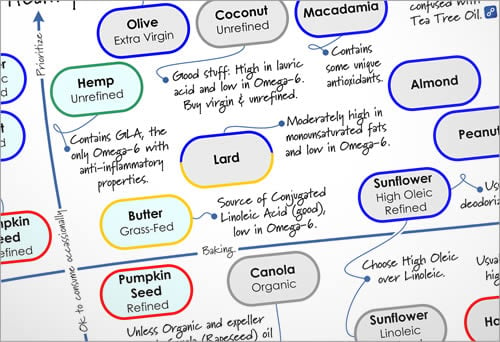
I've looked forever for some good, trustworthy, comprehensive source on how cooking fats stack up. I found it! I still have no idea where to get most of the good stuff, even if I could afford it, but this chart is very helpful and friendly in understanding the different uses for fats and oils in food and their relative merits. Without having to keep track in my head anymore.
And the title is from Isaiah 58:11 --
And the LORD shall guide thee continually, and satisfy thy soul in drought, and make fat thy bones: and thou shalt be like a watered garden, and like a spring of water, whose waters fail not.
Labels:
Nutrition
Tuesday, April 30, 2013
Probiotic Ramen
S. likes the traditional miso soup -- he has fond childhood memories of seeing his dad eat it -- but I still have a hard time stomaching tofu and seaweed. The kids and I, however, have found the perfect marriage of cheap convenience food with healthy stuff you can pat yourself on the back for:
Put cold water and vegetables together in a pot and bring to a boil; when boiling, add ramen noodles (reserving flavor pouch, as directed on packet) and cook for 3 minutes. The last minute or so of cooking, crack egg into boiling liquid and quickly stir to break it up. Remove from heat and add contents of flavor pouch. When soup has cooled enough to eat, add miso and stir to incorporate. Makes 2 servings.
TIP: miso is a live cultured food and for full benefit should not be subjected to temperatures hot enough to kill bacteria, though taste would be unaffected.
Probiotic Ramen Super-Galore
1 packet ramen, any flavor (not the instant styrofoam-cup kind)
2 c. water
frozen mixed vegetables, one cup or so
an egg
about 1 T. miso, or to taste
Put cold water and vegetables together in a pot and bring to a boil; when boiling, add ramen noodles (reserving flavor pouch, as directed on packet) and cook for 3 minutes. The last minute or so of cooking, crack egg into boiling liquid and quickly stir to break it up. Remove from heat and add contents of flavor pouch. When soup has cooled enough to eat, add miso and stir to incorporate. Makes 2 servings.
TIP: miso is a live cultured food and for full benefit should not be subjected to temperatures hot enough to kill bacteria, though taste would be unaffected.
![]() |
| I've basically done this styrofoam version in gas stations on road trips, but am happy to bring it up a notch . |
Monday, April 15, 2013
Confidence
So, a while ago I posted that I was listening to a Healthy Life conference thing, at least a little of it, and it’s been interesting but not groundbreaking for me. I’ve had a couple of thoughts and realizations as I’ve heard from various notable names in what I’ll call the traditional food movement.
One is, I know a lot. I think I tend to underestimate my knowledge of this field, trying to be humble and recognizing that I don’t have any official credentials. But I've started to notice more and more, and it was confirmed by these interviews and podcasts, that it doesn't take official expertise to be on the cutting edge of real nourishing and flourishing. This isn't just a hobby, and while trying to give my family the best possible life I can, I'm definitely capable of contributing more openly to my community. A majority of the informed, inspiring people that I've seen speak about food were complete novices and outsiders when they started. In fact, you almost have to be, since food 'insiders' are now all just large agricultural factory farms and slaughterhouses, distribution conglomerates, and seed/chemical monopolies, and no positive change is going to come from that direction. So, I don't have the handicap that maybe I've thought I had.
The other thing I've been realizing, is that while I feel extreme compared to my friends and get teased by my husband for trying to make everything harder, there are people taking this waaaay more seriously than I am. That was one of the things that made me a little uncomfortable listening, in fact, because while the information mostly wasn't new or scary to me, the condescension or willful blindness to cost and other factors was sometimes offensive.
So I've been trying, in my own writing, to walk that careful line between humility and confidence, avoiding elitism along the way, and I guess I'm doing OK. At the same time, maybe I can lean a little more towards confidence. I can even add a little Word of Wisdom perspective that I noticed was still highly lacking from the conversations between the adherents of all the different modern diets.
So, leaning more toward confidence, what am I confident in? For a simple beginning, whole milk, egg yolks, and butter. Breakfast. Soaking whole grains and dried beans. Freshly ground wheat. Water to drink.
Labels:
Nutrition
Thursday, April 22, 2010
Four Simple Rules
Eating habits and preferences are way too complex to really pare down into simple rules, but here are four that I've liked lately:
1. Eat something raw every day.
2. Eat your fruits and veggies first.
3. Eat regular meals.
4. Make your fat count.
Of course I'll have to explain a little, though. "Raw" isn't always what you think it is. (Though I certainly don't have any great desires to eliminate all cooked food!) If it's ever been subjected to high heat and/or pressure, it's not raw -- so for example, cold cereal with milk and a glass of orange juice has nothing raw. Everything there has been pasteurized or cooked in some way, unless you bought the juice oranges and squeezed them yourself. Even raw almonds, apparently, have been pasteurized in our food system. What you're aiming for with raw is not necessarily nutrients, but enzymes. They're not really measuring them yet, but it's a good bet you want them in your body, and they're all knocked out of the picture by heat/pressure. So fresh, obviously, and also dried counts. Get at least a little every day.
Eating fruits and veggies first sounds simple, but it's hard not to rationalize skipping straight to the richer main dish when your stomach is growling. But let me tell you: the difference just in portion allotment when I do or don't follow this rule is amazing. I never regret forcing myself to eat the crunchy stuff first.
Eat regular meals. Assumed: pretty much all at home. I don't really believe in the culture of convenience food, including snacking. And despite headlines about eating little bitty meals all day, there are some data that back me up. Not that I don't snack, but there are no exceptions to eating regular meals at my house.
Fat has been dragged in all sorts of directions in the past few decades, from the biggest evil on the planet to "good" and "bad" fats, to Atkins, you name it. It turns out that the worst fats may be trans fats, and after them, a lot of the polyunsaturated oils. Yup, sunflower oil, etc. They're too long, your body doesn't actually know how to digest them, and so they float around in your lymph system (seriously) until getting spewed back into a vein and then ending up...wherever your body can stash them because it can't use them very well. Sort of like that junk closet/junk drawer/junk desk in your house, you know the one. (I have a secret theory that the increasing prevalence of muffin-top waists on otherwise skinny, fit people is due to this.) OK. So what do you do? If there's anything that you think is good for you (from fish oil to green beans), I understand that good old-fashioned butter makes it all go down easier. Not just to your taste buds, but to your body. They've shown that you don't really get anything out of fish oil unless it's accompanied by saturated fat. And the same goes for a majority of vitamins and minerals, even the water-soluble ones. SO. Don't indulge in ice cream and doughnuts unless for a special occasion, but buy cream and put it on your oatmeal. Buy butter and put it on your brussels sprouts and fish. Put Parmesan and olive oil and butter and cream ALL in your homemade minestrone -- it's the best food ever, my heirloom recipe is in the sidebar.
And, for this week's meals:
Homemade pork n' beans, frozen mixed vegetables, whole wheat biscuits (with our first raw honey ever -- we're not quite sure if we like it).
Chicken cacciatore, salad.
Curried veggies and rice.
Flounder, filled with bread crumb stuffing, broccoli, baked potatoes.
Pizza, salad.
Leftovers.
Sourdough pancakes, bacon, applesauce.
Subscribe to:
Posts (Atom)